.png)
Animation and Gaming Studios: Specialized Office Space Requirements in Bangalore
- Jan 6
- 6 min read
Culture of AVGC-related businesses in Bangalore. Big emphasis should be placed on the auxiliary requirements on acoustical isolation along with abnormal power and cooling loads to sustain the render farms and production machinery. An appropriately planned layout balances studio-qualified sound treatments with data-center-caliber infrastructure while conducting itself as a collaborative creative office.
AVGC Context of Bangalore
Bangalore is the axis of AVGC (Animation, Visual Effects, Game, and Comics), actively backed up by the presence of state and national AVGC-XR policies that encourage dedicated studio and production infrastructure.
Many studios here need hybrid spaces: open‑plan production floors, enclosed audio rooms, motion‑capture or XR areas, and back‑of‑house server or render rooms.
Core space zoning for studios
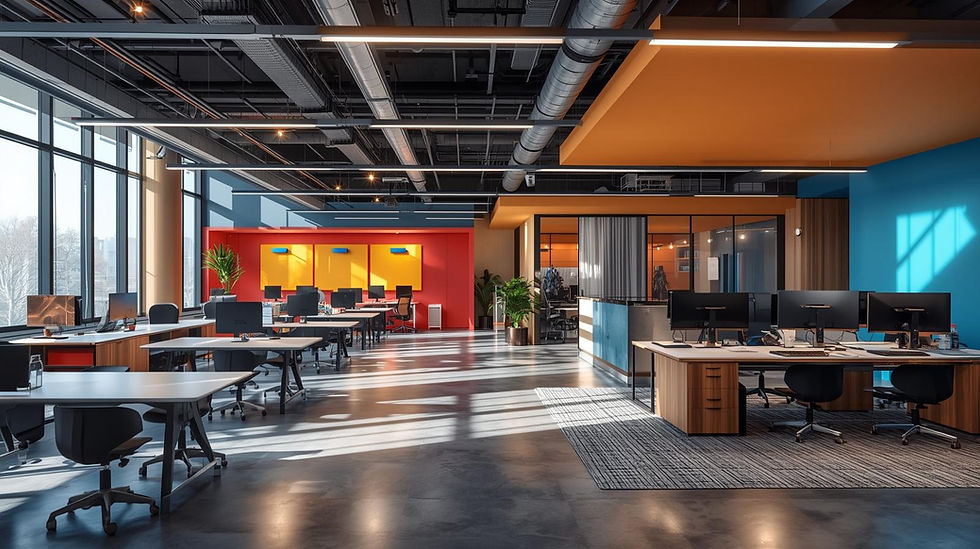
A general functional zoning scheme would include open artist and developer workstations, sound-treated edit/VO rooms, screening/preview rooms, collaborative lounges, and secured server or render rooms.
Successful studio campuses started to show the benefit of a large central atrium or hub space as a connecting element for teams, the benefit an acoustic barrier between the loud and the quiet functions.
Acoustic treatment essentials
Studio acoustics essentially make two objectives: one, sound isolation-dampening sound travel between rooms: and the other, internal treatment-controlling reflections, echo, and reverberation within each room.
For isolation, generally, the technique uses a double-layer drywall system with damping compounds, cavity walls stuffed with mineral wool, and resilient channels or isolation clips, often in combination with sealed solid-core doors.
Interior acoustic treatment
In interior edit and VO review rooms, a combination of broadband absorption panels, corner bass traps, and limited diffusion surfaces is used to improve clarity and reduce flutter echoes.
The use of foam, fabric-wrapped fiberglass panels, and PET felt panels is widely adopted for the taming of mid- and high-frequency reflections while keeping spaces visually clean for client visits.
Layout and Noise Control
Implementation of corridors, rooms used for storage purpose, or second partitions to create an acoustic buffer separating the noisier activities from quiet rooms, such as the gaming pods, testing bays, or collaboration areas.
Ceiling and floor treatments, including acoustic ceilings, carpets, or raised floor systems, provide some attenuation with respect to structure-borne noise from footsteps, rolling chairs, and nearness to elementary mechanic noise.
Render Farm and Power Density Requirements
Modern render farms and high-performance workstations can have rack power densities of 20–30 kW on a diminutive footprint resembling edge data centers.
This level of load requires robust electrical design with dedicated server-room feeders, high-capacity power distribution units (PDUs) and careful phase balancing.
Cooling and Environmental Control
With the increase in rack power density, heat output grows sharply, thus requiring enhancement of cooling strategies within the studio, with often separate precision cooling for server or render rooms.
Thanks to raised floor, dropped ceiling and concealed cable path design, great airflow performance, cable organization and the integration of acoustic and cooling features are achieved.
Reliability, UPS and Backup
Studios would typically maintain UPS for critical racks and workstations and genset backup, thus protecting the ongoing projects and renders that are scheduled overnight.
Electrical specifications usually follow the national standards and energy efficiency guidelines that control lighting power density and foster the selection of efficient equipment.
Office Design Specifics for Bangalore Studios
In Bangalore, studios often cohabit with tech and game-dev firms and favour flexible open plans married with enclosed, acoustically treated pods and rooms.
Close proximity to stable grid power, fibre connectivity, and industrial‑grade substations, such as those in designated KIADB or IT parks, support heavy loads for rendering and networking.
Amenities and Collaborating Spaces
Central hubs with cafés, lounges, and informal meeting spots nurture creative cross-pollination, with the same idea carried forward by global studio standards wherein atriums and shared social spaces are created.
Breakout rooms, VR demo zones, and small screening spaces were given just enough acoustic treatment not to leak conversations, previews, and gameplay tests into work bays.
Summary Checklist for Landlords and Tenants
Seek buildings providing high power availability, redundancies, and cooling capacity in support of future render-farm loads.
Layered acoustic isolation treatment must be prioritized along with the proper treatment of rooms where sound matters, and the design must cater for noise control so collaborative spirit keeps gliding through this studio environment.
Login Realty fills a strategic space bridging the divide between highly specialized animation and gaming studio requirements and the realities of Bangalore's commercial real estate market. The dedicated commercial advisory team looks intently at understanding the very nuanced needs, such as acoustic isolation, render-farm-ready power and cooling, and high-bandwidth connectivity, to filter buildings and landlords who can very much comply with said specifications. Beyond merely searching for space, Login Realty looks to work with fit-out partners, acoustic consultants and MEP engineers so that studios can move into spaces that are not only pleasant to look at but also technically mapped into their production pipelines and long-term scalability in key micro-markets across the city.
Frequently Asked Questions (FAQs)
1. What makes animation and gaming studios different from normal IT offices?
Animation and gaming studios run GPU‑heavy workstations, render farms and audio rooms, so their power, cooling and acoustic needs are closer to mini data centres plus recording studios than regular IT floors. They also need specialised zoning for quiet edit/VO rooms, noisy testing bays and collaborative creative areas, which standard plug‑and‑play offices rarely address by default.
2. How much power does a render farm typically need in an office?
Power demand depends on rack count and hardware, but even modest render racks can approach 5–10 kW per rack, while high‑performance setups may push into the 10–20 kW range similar to high‑density data‑centre cabinets. Studios must ensure building transformers, risers and panels can safely support this density without overloading existing circuits.
3. What kind of cooling is required for render rooms?
Render rooms generate continuous heat, so they usually need dedicated precision cooling or at least an independent high‑capacity AC system rather than sharing comfort cooling with open workstations. Techniques such as hot‑aisle containment, in‑row cooling or rear‑door heat exchangers used in data centres can be scaled down for studio render rooms to keep temperatures stable during overnight renders.
4. What is the difference between soundproofing and acoustic treatment in studios?
Soundproofing (isolation) focuses on stopping sound from entering or leaving a room by using mass, airtight construction and decoupling techniques. Acoustic treatment manages reflections and reverberation inside the room using absorbers, diffusers and bass traps so that dialogue, game audio and music sound clear and controlled.
5. Which rooms in a studio need the highest level of acoustic treatment?
Voice‑over booths, control/edit rooms, game‑audio mix rooms and small screening rooms require the most careful isolation and internal treatment because they handle critical listening and recording. Open production floors, testing bays and collaboration zones benefit from lighter treatment and soft finishes to reduce chatter and echo but do not usually need full studio‑grade isolation.
6. What basic acoustic materials work well for gaming and animation spaces?
Common solutions include fabric‑wrapped wall panels, PET felt panels, ceiling baffles, acoustic screens and bass traps in corners for low‑frequency control. Soft furnishings like rugs, upholstered furniture and acoustic curtains around glass partitions also help tame reverberation in open‑plan gaming or production areas.
7. How should studios plan layout to control noise?
Noisy functions such as testing labs, gaming pods and social zones should be buffered away from highly sensitive edit, VO and review rooms using corridors, storage, meeting rooms or acoustic partitions as separation. Zoning by noise level, combined with targeted acoustic treatment and pods, prevents team chatter and game sound from bleeding into focused production or recording work.
8. Do Bangalore office buildings typically support render‑farm loads out of the box?
Many Grade‑A tech parks offer strong base power, but not every building is designed for sustained high‑density racks and additional cooling that render farms demand. Studios often need landlord approval for electrical upgrades, extra panels and dedicated server‑room cooling, which should be evaluated during site selection rather than after lease signing.
9. What should studios ask landlords or developers before leasing space?
Key questions include: available power per sq ft and scope for enhancement, backup and UPS options, structural capacity for additional AC units, and flexibility for acoustic build‑outs and raised floors. It is also important to confirm rights for 24/7 operation, rooftop or external unit mounting and fibre connectivity for large asset transfers and cloud rendering workflows.
10. How can Login Realty help animation and gaming studios in Bangalore?
Login Realty specialises in matching studios with buildings that can handle high‑density power, robust cooling and acoustic‑heavy fit‑outs in Bangalore’s key micro‑markets. The team works with landlords, MEP and acoustic consultants to ensure shortlisted spaces are technically feasible for render farms, audio rooms and hybrid creative office layouts before clients commit to a lease.


Comments