.png)
From Bare Shell to Ready-to-Move: Choosing the Right Type of Office Space in Bangalore
- Dec 12, 2025
- 10 min read
Bangalore's commercial real estate spectrum is also replete with all offerings right from raw structural shells to fully furnished turnkey offices. Raw shell is a blank canvas for custom builds; warm shell delivers semi-ready infrastructure; fully furnished spaces allow for immediate occupation. Each one holds a purpose for different business psychologies, budgets, and timelines in high-demand micro-markets such as Whitefield, ORR, and Koramangala.
Bare Shell Offices Explained
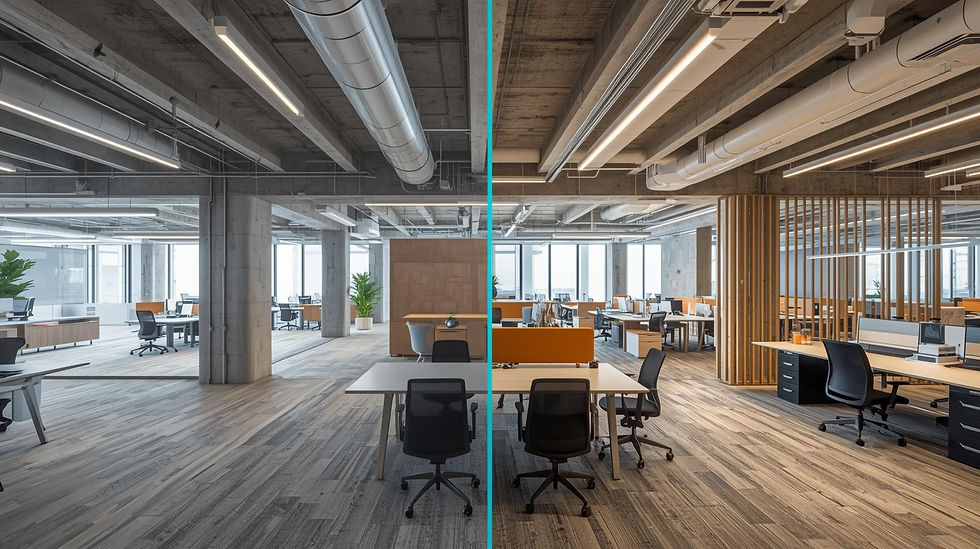
Bare shell offices are the most basic form of delivery in commercial leases. The landlord delivers the structural shell comprising columns, beams, slab-to-slab heights, external walls, and basic core services like staircases, lifts, and fire escapes. No internal finishings are done; flooring remains cement-finished, walls are unpainted and ceilings absent; and the service installations of the HVAC system, electrical wiring, plumbing, or lighting are left uninstalled except for incoming mains.
The responsibility for the fit-out of the premises, in all respects, lies solely with the tenant. Partitioning, specialized systems, and everything else are entirely the responsibility of the tenant-much like this arrangement dominates in Bangalore within large-format Grade A parks, where enterprises look for 50,000+ sq ft contiguous spaces. It allows for a fine-tuned alignment with international workplace standards incorporating agile zones, wellness pods, or lab-grade HVAC that cannot be satisfactorily provided by generic setups.
Benefits of Bare Shell to the Tenants
All over the world, maximum customization can be viewed as the biggest advantage. The business is creating the layout with maximum density potential-70 sq. ft. per seat for high-collab tech teams or 120 sq. ft. for finance firms more populated with executives. Brand identity meshed in through feature walls, custom millwork, and acoustical treatments to noise profiles.
But it becomes far more economical in the long run. Base rents run 20-30% lower than fitted spaces-roughly ₹60-90/sq ft for ORR towers compared with ₹100+ for furnished counterparts. Rent-free periods of 6-12 months negotiated with the landlord, coincide with the timelines for fit-out and amortize CAPEX across a 5-10 year lease. The companies recoup the value in the form of interior fit-out asset ownership, which they can either claim back or relocate at exit.
This eases the way for sustainability integration. From day one, tenants can insist on low-VOC paints, recycled partitions, zoned LED systems, all hitting IGBC or LEED targets without retrofits. In Bangalore, where a lot of focus is on ESG, this is something that presents MNCs with light against their Singapore and Hyderabad peers.
Disadvantages with Mitigation Strategies
Also, the longest lead time is the chief impediment, with full fit-out taking anywhere from 4 to 8 months, delaying revenue ramps for new GCCs or expansions. Delays come from iterations in design, BMC approvals, and supply chain issues for imported fittings.
Since most often high upfront CAPEX costing ₹2,500-4,000/sq ft would require a very strong balance sheet, mid-sized firms would be in a position to overcommit without the landlords' financial contributions that such leading developers as Prestige or Sobha may extend to about 20-30% of the cost for the anchor tenants.
To mitigate, engage turnkey contractors early on and start phasing out fit-outs focusing first on the core shell, followed by furniture. Login Realty, an advisory firm, benchmarks timelines across 50+ buildings and highlights risks like slab curing delayed by monsoons in North Bangalore projects.
Ideal Scenarios where Bare Shell Fits
Prefer bare shell for corporates that are well-established with above 200 seats, who have more than five years of horizons. Think tech giants expanding their Bangalore footprint-building signature campuses, Hebbal or Devanahalli-elevating the sights to that of the aesthetics of their HQ. On the other hand, stabilized players from BFSI, busy in Indiranagar, opt for custom trading floors rather than generic ones.
Good for operations requiring specialized infrastructure, AI labs need server farms, biotech companies need clean rooms. When growth visibility is beyond 24-months, bare shell locks below market rents while Bangalore escalates at 10-15% annually.
Limitations and Mitigation Strategies
Long lead times mean new GCCs or expansions take 4-8 months for complete fit-outs, delaying their revenue ramp-ups. Design iterations, BMC approvals, and hiccups in supply chain for imported fixtures result in such delays.
High initial CAPEX, usually ₹2,500-4,000/sq ft, necessitates a prudent balance sheet. Mid-sized enterprises risk overcommitment without any contribution by the landlord, which some of the best developers like Prestige or Sobha sometimes provide in anchor tenancies at 20-30% of costs.
Mitigation shall be achieved by early-turn-key contractual award and occurrence of fit-outs: core shell first, all furniture next. Advisors like Login Realty benchmark time over 50+ buildings and highlight risks such as monsoon delayed slab-cure in North Bangalore projects.
Ideal Situations for Bare Shell
Corporates with 200 or more seats and a horizon greater than 5 years mostly prefer bare shell. The technology biggies show expansion in Bangalore-dream new GCCs in Hebbal or Devanahalli-grand signature campuses like HQ. Common BFSI stalwarts trading in Indiranagar set up unique custom trading floors rather than off-the-shelf.
This is for operations with unique infrastructure needs like AI labs needing server farms or biotech requiring clean rooms. For growth visibility beyond 24 months, bare shell locks below-market rents in Bangalore's 10-15% yearly increases.

What are Warm-Shell Offices?
Warm shell is the middle-of-the-road kind, wherein little basic but finished products are delivered: vitrified flooring, painted walls, suspended ceilings, basic LED lighting grids, ducted HVAC as per 1 ton/300 sq ft, electrical sub-panels, fire sprinklers, and washroom pods all next to demised area.
Tenants place in furniture, internal partitions, IT cabling, and branding, or approximately 40-60 days of labor. Bangalore's mid-market boom is seeing warm shell proliferating in HSR, Bellandur and even secondary spaces from Whitefield, bridging the enterprise scale with SME budgets.
Key Benefits of Warm Shell
Initial occupancy times for bare shell are halved, extremely important for scaling startups just hitting that 100-seat milestone. Basic infrastructure arrives tested and thus reduces commissioning risks found with HVAC unbalances common in tenant-led builds.
Reduced capital expenditure to ₹1,200-2,000/sq ft, with landlords providing 50-60% on heavy infrastructure. Rents are about ₹80-110/sq ft-all the right elements of both affordability and quality, especially for the buzz of Koramangala's startup culture, where plug-and-play premiums stretch over ₹130.
Flexibility: recarpet column grids for hot-desking or add breakout pods without structural changes. In hybrid periods, a warm shell maintains density shifts from 60 to 90 sq ft/seat seamlessly.
Potential Downsides
All constraints bind relatively fixed services within the building—any change of duct routes or increased power densities (more than 10-12 VA/sq ft) is considered optional expense. The old designs may even not be having these smart contemporary twists like underfloor cabling and zoned controls.
Higher base rent-than-a bare shell may somewhat require cunning negotiations, especially if not going anchor. Tenants still manage interior vendors and divert FM bandwidth during ramps.
Counter these by site visits to HVAC mock-ups and insist upon modular ceilings. Loggan Realty's inventory scan highlights warm shells with upgrade clauses like extra UPS provisions in Electronic City hubs.
Best Fits for Warm Shell
Growing SMEs and mid-tier GCCs (50-300 seats) thrive here, requiring time without the burden of bare shell. Tech services firms within Manyata Tech Park make rapid adjustments to their collaborative suites, beating the furnished waitlists.
It is ideal for 2-5 year leases that will require some amount of custom touch but are kept under tight control with CAPEX. Warm shell will allow quick pivots into hybrid models with no sunk costs amidst Bangalore's moving talent market.
Fully Furnished, Plug & Play Complete:
Fully furnished offices arrive ready to occupy with ergonomic workstations (5-6 ft modules), executive cabins, meeting pods, reception desks, pantries with appliances, server racks, full IT cabling, and AV systems—everything shall plug in from day one except some minor branding.
Managed offerings from WeWork or Awfis bundle cleaning services, security, and utilities within the benchmark seat pricing (₹15,000-25,000/month). Standalone furnished leases in Salarpuria towers charge ₹110-150/sq ft, thereby assuring zero downtime.
Advantages of Fully Furnished
Profitability of speed—7-30 days to occupy—becomes critical for market validation pilots or sales bursts. There is no CAPEX apart from IT onboarding, leaving cash for growth while OPEX predictability helps P&L planning.
Flex models shine with scalability: allowing add-on or cuts of 20% seats quarterly without penalties. Amenities like gyms and cafeterias help retention in a 20% attrition environment in Bangalore.
Downsides to Be Considered
Pricing at a premium loses its sheen after some time-it is probably 15-25% more for course 5 years. Layout rigidity fetters reconfiguration; generic design erodes brand identity for scale-ups.
A heavy burden awaits termination clauses-money for depreciating furniture. In a pure lease, upkeep lingers on the tenant after handover.
Select hybrids: furnished for now; flexible for a custom build in the future. Login Realty has paired these turnkey solutions for seamless transitions from inventory in Whitefiled.
When Fully Furnished Wins
Velocity is the driving concern for startups, foreign franchises, and project teams under 100 seats. Consultancies setting up hubs in Bangalore or e-commerce companies ramping up festive teams would have saved months by taking this option over builds.
Short (6-24 months) or variable headcount makes it a necessity, especially when located close to the airport for client-facing operations.
Comparative Decision Framework
Bare shell, low-profile all formats, attract the least amount of rent from the bidding boards, varying from ₹60-90 per sq ft, demanding the highest ever cash for fit-out costs ranging from ₹2,500-4,000 per sq ft and giving the longest timelines for fit-out from 4-8 months. This would suit every large enterprise considered to take leases above 5 years, where customization would directly relate to stable growth and international scenario standards. Warm shell provides an equilibrium, with rents varying from ₹80-110 per sq ft, moderate CAPEX at ₹1,200-2,000 per sq ft for partitions and furniture, and move-ins between 1 and 3 months; these would suit SMEs or growing GCCs that need speed along with flexibility concerning the layout on terms of 2-5 years. Plug and play administration command a premium rent of ₹110-150 per sq ft, low CAPEX of ₹300-800 per sq ft for IT tinkering, and fastest occupational speeds of 0-1 months are a perfect match for the startups, project teams, or short-horizon pilots of less than 2 years, where speed leads over customized design.
The Indian hub with the prime office ecosystems of ORR and Whitefield has seen a comparative analysis of trade-offs in the purest possible form. Bare shell gives a long-term value under control of ownership-like flexibility, amortized savings amidst stir of annual escalation by 10-15%. Warm shell minimizes risks through hybrid work shifts by putting in tested HVAC and finishes that take on Board headache of construction activities of bare shell type. Fully furnished options take care of cash conservation equally as well as scalability for volatile headcounts, albeit costing 15-25% extra cumulatively when rented for a long time compared to those custom-built. Tenants continuously benchmark challenges against runway and headcount forecasts and micro-market dynamics; Login Realty advisors put these against inventories so as to maximize overall occupancy economics.
Market Trends in Bangalore
ORR is capturing 40% of the latest supply available in warm/furnished formats, which is possible because these formats are 25% absorbed by the metro link. In the entire city, the vacancy has dropped down to 9%, which is pushing up the premiums near the Yellow Line stations. Login Realty matches those moves in tenant profiles to the evolving inventory.
Final Thoughts on Selection
This would have the choice flying along the runway, according to CAPEX tolerance, intended growth curves-bare for legacy builders, warm for scalers, furnished for sprinters. Site audits and lease audits are the keys to sealing the best picks within Bangalore's competitive landscape.
Frequently Asked Questions (FAQs)
1. What is the basic difference between bare shell, warm shell, and fully furnished offices?Bare shell is a raw space with only the structural frame and core services; warm shell is semi-finished with flooring, basic ceilings, lighting, and HVAC in place; fully furnished or plug-and-play is a complete ready-to-use office with furniture, partitions, and meeting rooms already installed.
2. Which office type is most cost-effective in the long run?
For tenants with a long lease horizon (typically 5 years or more), bare shell can be the most cost-effective over time because the lower rent and custom fit-out can be amortised across the lease term. Warm shell is cost-balanced for 2–5 year stays, while fully furnished is generally best for short to medium terms where speed and flexibility matter more than long-run savings.
3. When should a company choose a bare shell office in Bangalore?
Bare shell makes sense for large or established companies with clear headcount visibility, strong CAPEX capacity, and a desire for highly customised, branded interiors. It is particularly suitable for enterprises setting up flagship offices or GCCs in major corridors like Outer Ring Road, Whitefield, or North Bangalore.
4. Who is best suited for warm shell office spaces?
Warm shell spaces are ideal for growing SMEs, mid-sized GCCs, and tech or consulting firms that want faster move-in than bare shell but still care about tailoring the floor plan, workstations, and collaboration areas. This format works well for tenants planning a 2–5 year stay and looking for a balance between cost, speed, and control over design.
5. What kind of businesses should prefer fully furnished or plug-and-play offices?
Fully furnished offices are well suited for startups, foreign companies testing the Bangalore market, project-based teams, and organisations with uncertain headcount or short (<2–3 year) horizons. They are also useful as temporary “swing spaces” while a long-term bare or warm shell fit-out is being completed.
6. How does move-in timeline differ across the three models?
Bare shell usually involves the longest timeline because tenants must handle complete design, approvals, and construction. Warm shell shortens this significantly, since infrastructure like HVAC and lighting is already in place and only internal layout and furniture are pending. Fully furnished spaces typically offer the fastest move-in, sometimes within days, because the main workstations and meeting rooms are ready.
7. What are the typical upfront costs I should plan for?
With bare shell, tenants should budget for the full interior fit-out—design, civil work, MEP, furniture, and IT. In warm shell, the landlord has already absorbed a portion of this, so tenants mainly spend on partitions, furniture, and technology. Fully furnished spaces usually have the lowest upfront CAPEX, as most of the fit-out is already paid for and amortised into the rent or per-seat pricing.
8. Does choosing a bare shell or warm shell impact brand and employee experience?
Yes. Bare shell gives maximum control over the look, feel, and functionality of the workspace, allowing complete alignment with brand guidelines and employee experience goals. Warm shell still offers substantial room for customisation. Fully furnished spaces provide the least control over core design, but can still be branded with graphics, colours, and minor tweaks.
9. How can a tenant reduce risk when selecting among these options?
Tenants can reduce risk by clearly defining lease horizon, headcount scenarios, and budget before shortlisting; visiting multiple buildings to compare handover conditions; and carefully reviewing technical specifications such as power load, HVAC capacity, and floor plate efficiency. Working with an experienced commercial advisor such as Login Realty also helps in negotiating rent-free periods, fit-out contributions, and flexible clauses that align with the chosen model.
10. Can I combine different models as my company grows?
Yes. Many companies in Bangalore start in a fully furnished or managed office to move quickly, then shift to warm or bare shell space once operations stabilise and headcount grows. A phased approach—using plug-and-play space for immediate needs while a custom shell office is being built out—can give both speed and long-term cost efficiency, and this kind of transition is commonly planned with support from firms like Login Realty.


Comments